
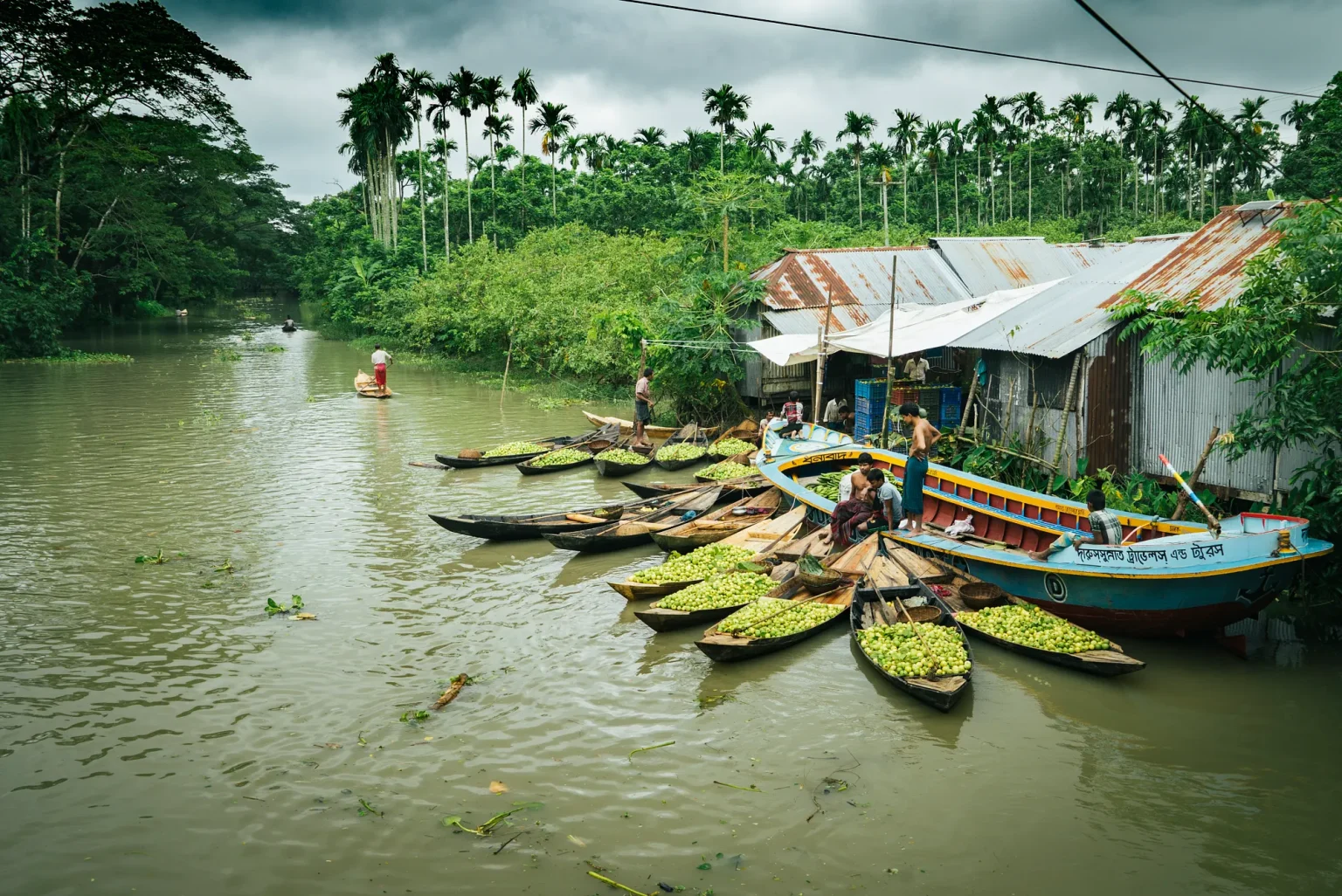
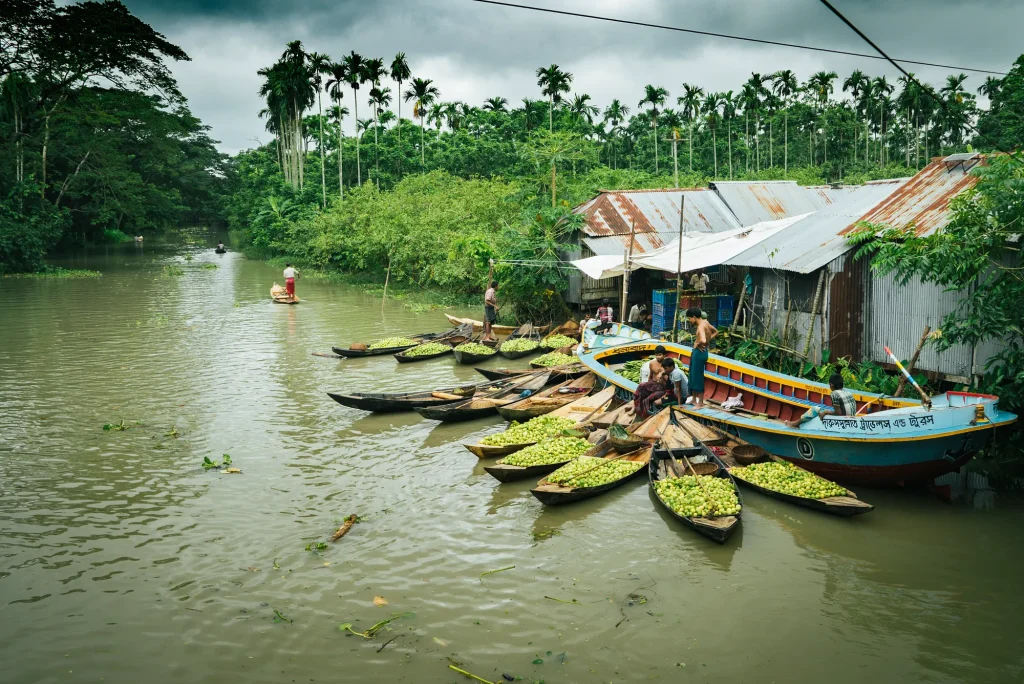
When most people imagine floating markets, they picture Thailand’s Damnoen Saduak or the Cabiao Floating Market in the Philippines colorful boats brimming with tropical produce, tourists navigating narrow canals, and vibrant daily trade. Few realize that Bangladesh, with its vast tidal rivers and waterways, hosts its own floating markets, most notably those centered around guava farming in the Barishal Division.
Here, boats, not stalls, form the marketplace. Farmers paddle through narrow canals, selling their freshly harvested guavas to buyers, traders, and tourists. Among them, the Bhimruli floating guava market in Pirojpur District stands out as the largest in southern Bangladesh, drawing local and international attention every guava season (Vocal Media).
But while the scene is idyllic, the realities behind the floating markets are changing. Climate change, rising temperatures, and erratic rainfall are creating unprecedented stress on guava farming, a cornerstone of the local economy and a key contributor to South Asia’s tropical fruit production.
Guava Farming in South Asia: Scale and Significance
Guava (Psidium guajava L.) is native to tropical America but has been cultivated across South Asia for centuries. Bangladesh, India, and Pakistan together account for nearly half of global guava production, making the region a critical supplier to domestic and international markets (Tridge).
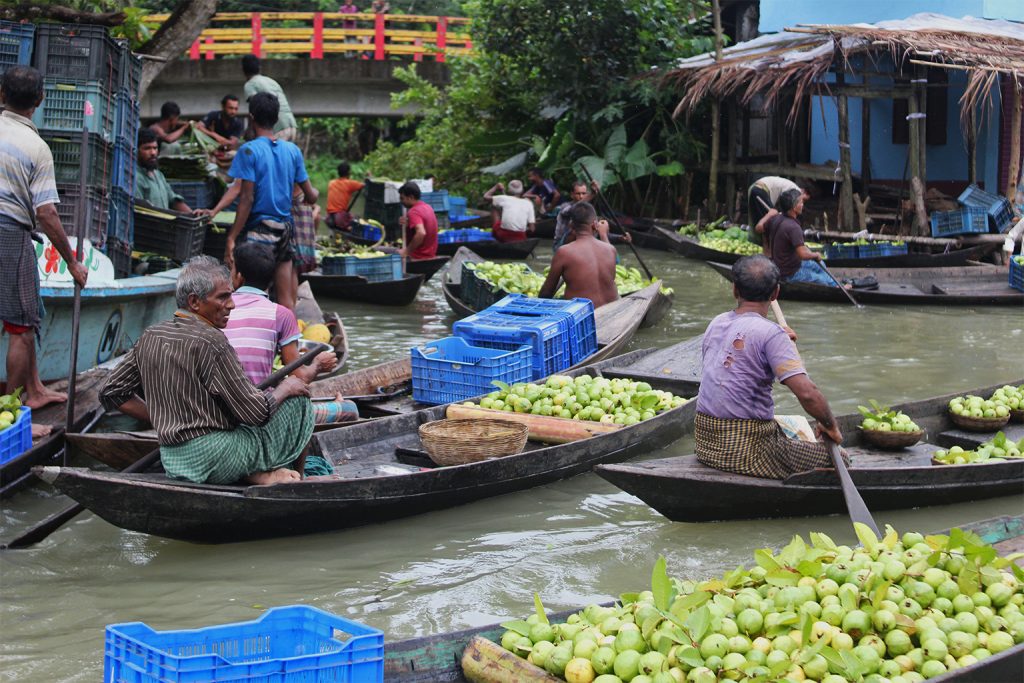
In Bangladesh, Barishal, Pirojpur, and Jhalakathi districts host multiple guava varieties, including Purnamandali, Swarupkathi, and Palalata. These varieties have thrived on smallholder farms for generations, with farmers relying on tidal canals for irrigation and transport. Floating markets are not just economic nodes; they reflect centuries of adaptation to a water-centric landscape (TFNet).
Climate Change: A New Threat to a Traditionally Resilient Crop
Despite guava’s drought tolerance, recent years have exposed its vulnerability. Farmers in Bangladesh have observed:
- Erratic rainfall
- Delayed monsoons
- Extreme heat events
- Reduced flowering and fruit set
Haralal Halder, a Pirojpur guava farmer with over 45 years of experience, recalls never witnessing such heat spikes during the critical flowering season until recently. In 2023 and 2025, premature dropping of roughly one-third of blossoms in his orchard reduced yields dramatically (Mongabay).
This trend mirrors experiences across South Asia. In India’s Uttar Pradesh, researchers report that rising temperatures and changing rainfall patterns are disrupting flowering cycles, delaying fruit ripening, and reducing both yield and fruit quality. In Larkana, Pakistan, unpredictable hot weather has caused a 60% decline in guava production over eight years, pushing farmers to shift toward alternative crops like hog plum and banana (Dawn).
Declining Production in Bangladesh
Official data from Bangladesh’s Department of Agricultural Extension (DAE) confirms the downward trend:
| Fiscal Year | Production (tons) | Cultivated Area (hectares) |
|---|---|---|
| 2018–19 | 31,747 | 3,345 |
| 2022–23 | 25,080 | 2,750 |
| 2023–24 | 23,601 | 2,596 |
Yields per hectare also fell from roughly 11 tons to 9.01 tons, primarily due to high temperatures and erratic rainfall during flowering and fruiting (Save the Children).
The Floating Market: Culture, Commerce, and Community
Floating markets are more than trading hubs; they are living cultural landscapes. At Bhimruli, boats float side by side in tidal canals, stacked with guavas arranged in banana-leaf baskets and plastic crates. Farmers paddle long distances from villages such as Bhimruli, Dumuria, Shatdashakathi, and Kirtipasha. Women participate equally, transporting fruit and managing sales.
Tourists, diplomats, and government officials frequently visit these markets, recognizing them as unique representations of Bangladesh’s water-based livelihoods (Daily Star).
Economic Pressures and Farmer Vulnerability
While culturally rich, floating markets are economically fragile:
- Perishable product: Guavas cannot be stored long, forcing rapid sales often at lower prices
- Climate stress: Reduced flowering and fruit set shrink supply
- Market dependency: Many households rely on floating market sales for income
As a result, some farmers are abandoning guava cultivation, switching to banana, hog plum, lemon, and mango, which are less sensitive to climate variability (Dhaka Tribune).
Adaptation Strategies for a Sustainable Future
Experts suggest multiple approaches to sustain guava farming:
- Climate-resilient guava varieties
- Protected cultivation (shade houses or greenhouses)
- Improved irrigation and water management
- Optimized pruning and cropping schedules
Implementing these solutions will require investment, technical support, and extension services, especially for smallholder farmers.
Global and Regional Context
- South Asia accounts for nearly 50% of global guava production (Tridge)
- Extreme heat and erratic rainfall are already reducing yields and affecting fruit quality (Mongabay)
- Floating agriculture in Bangladesh is recognized as a climate-adaptive heritage practice (ResearchGate)
- Climate migration in Bangladesh highlights the socio-economic implications of environmental change (National Geographic)
Conclusion
Bangladesh’s floating guava markets are living symbols of heritage, culture, and resilience, yet they face unprecedented pressure from climate change. Declining yields, erratic weather, and market constraints are reshaping both the economic and ecological landscape.
Adapting to these changes will require climate-smart agriculture, policy intervention, and investment in market infrastructure. The rivers that have long supported trade may continue to float these markets, but without adaptation, the future of South Asia’s guava production — and the livelihoods dependent on it — hangs in the balance.
References
Guava yields in South Asia shrink due to unpredictable heat & rainfall — Mongabay
Barisal’s Floating Guava Market — Vocal Media
Floating guava markets in Bangladesh — TFNet
Guava storage needed to aid Jhalakhati farmers — Dhaka Tribune
Floating market culture & tours — Daily Star
Bhimruli Floating Guava Market trade & tourism — Voice7News
Floating agriculture and climate adaptation — ResearchGate
Climate-smart floating farming — Save the Children
Climate change drives migration crisis in Bangladesh — National Geographic
South Asia’s Floating Guava Markets & Climate Vulnerability
India–Pakistan 2025 heat wave — Wikipedia
Global guava production data — Tridge


Hi, this is a comment.
To get started with moderating, editing, and deleting comments, please visit the Comments screen in the dashboard.
Commenter avatars come from Gravatar.